It's June 2026, and every developer blog has the same article: "Codex vs Claude Code — The Ultimate Comparison." Benchmarks, pricing tables, context windows, SWE-bench scores. The comments section is a battlefield of partisans declaring their loyalty.
Here's what nobody's saying: the teams shipping the most code aren't picking one. They're using both — sometimes three agents — routing each task to the model that does it best.
And they're saving 40-60% on their inference bills while doing it.
The Comparison Nobody's Actually Making
Let's acknowledge the facts first. There are real differences between these agents:
| Dimension | Claude Code (Opus 4.7) | Codex (GPT-5.5) |
|---|---|---|
| Best at | UI polish, refactoring, system design | Speed, batch operations, test generation |
| Token efficiency | ~4x more tokens per task | Leaner token usage |
| Context ceiling | 1M tokens | 272K default, up to 1.05M |
| Ideal workflow | Deep, interactive sessions | Autonomous burst-then-review |
| Sweet spot | Complex, ambiguous problems | Well-defined, mechanical tasks |
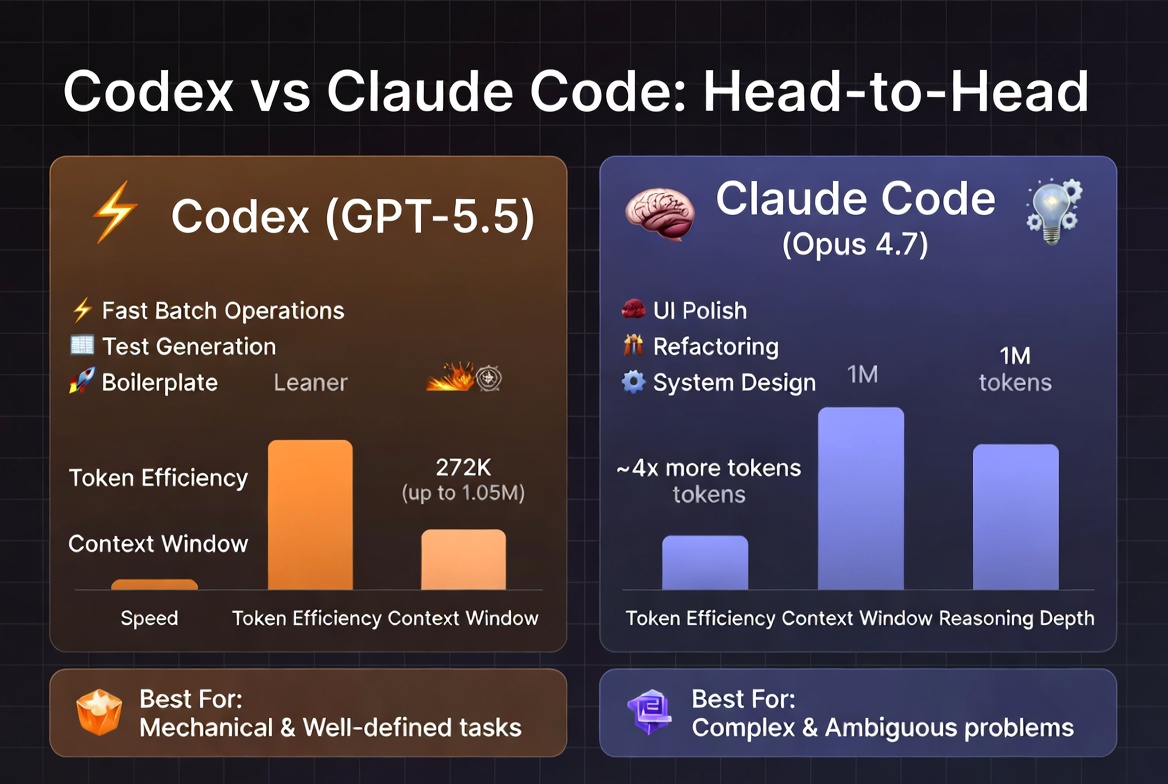
Visual breakdown of the tradeoffs. Codex wins on speed and token economy; Claude Code wins on context ceiling and reasoning depth. Neither wins on both — which is exactly why routing beats picking.
But every comparison article frames this as "which one should you pick?" as if developer tools were sports teams. The actual question developers should ask is: which model should handle this specific task?
Here's a real workflow from a team we work with:
| Time | Task | Agent | Tokens | Cost |
|---|---|---|---|---|
| Morning | Reads 15 PRs, writes detailed feedback | Claude Code | 1.2M | $3.60 |
| Midday | Generates 800 lines of test coverage | Codex | 280K | $0.56 |
| Afternoon | Traces a race condition through 8 files | Claude Code | 900K | $2.70 |
| Evening | Patches a failing CI pipeline config | Codex | 150K | $0.30 |
| Total | 2.53M | $7.16 |
Total: ~$7.16 for a full day of heavy AI-assisted development. If they'd used Claude Code for everything — the default for most teams — that same day would have cost ~$18. Codex for everything? They'd spend all afternoon guiding it through the race condition, burning tokens on dead ends.
The routing strategy isn't just cheaper. It's faster.
The Three-Layer Routing Model
After analyzing sessions from teams running both agents, we've identified a clear pattern. Tasks fall into three categories with natural model assignments:
Layer 1: Mechanical (Codex / fast models)
These tasks have clear acceptance criteria and limited ambiguity. The agent either gets it right or it doesn't — there's no "partially right" gray zone.
- Test generation from existing code
- Boilerplate: CRUD endpoints, form components, config files
- Code formatting and linting fixes
- Dependency updates
- Documentation generation from code comments
Why Codex wins here: It's faster, cheaper, and the output is binary-correct enough that you can review it in under 30 seconds. Claude Code's deeper reasoning is overkill for "write tests for this function."
Layer 2: Analytical (Claude Code / reasoning models)
These tasks involve trade-offs, design decisions, or understanding intent across multiple files.
- Architecture review and refactoring
- Bug hunting in unfamiliar codebases
- Code review with substantive feedback
- System design proposals
- UI polish and accessibility work
Why Claude Code wins here: Its deeper reasoning chain catches edge cases that faster models miss. On UI work specifically, multiple developer comparisons consistently give Claude the edge — its richer understanding of design patterns and accessibility pays off.
Layer 3: Hybrid (orchestrated)
These are the most interesting tasks: the ones that benefit from both agents working in sequence.
- Feature implementation: Claude Code designs the approach → Codex writes the implementation → Claude Code reviews
- Migration projects: Codex runs the mechanical transformations → Claude Code verifies correctness
- Performance optimization: Codex profiles and identifies hotspots → Claude Code proposes architectural changes
The orchestration pattern is where the biggest savings live. One team we spoke to runs a pipeline where Codex handles all the "grunt work" PRs (test coverage, formatting, dependency bumps) in batch overnight, and Claude Code does the morning review pass that used to take a senior engineer 2 hours. Their inference bill went down 42% while shipping more code.
The Hidden Cost of Context Switching
There's a catch to this multi-model strategy, though. And it's the same catch that makes the "just use both" advice useless without the right infrastructure.
Every time you switch models mid-session, you lose your context. The system prompt, the conversation history, the tool outputs — everything gets re-sent from scratch. On a long session, that's 50,000+ tokens of redundant transmission.
Here's what that looks like in practice:
Every switch is a cache reset. Anthropic's prompt cache has a 5-minute TTL — take a break to review Codex's output, and your Claude Code cache is gone. OpenAI's automatic caching helps, but it's not session-persistent either.
The multi-model strategy works in theory. But without infrastructure that preserves context across model switches, you're paying a hidden tax on every handoff.
Enter Session-Aware Routing
This is exactly the problem Synrouter was built to solve. Instead of treating each API call as an isolated request, Synrouter maintains session-level context that persists across model switches.
Here's how the same multi-model workflow runs through Synrouter:
Total: $0.103 for a four-turn multi-model session.
Without Synrouter: $0.31 (all cold starts, no trimming, 3x the cost).
The difference is three mechanisms working together:
1. Session-Lifetime Caching
Unlike Anthropic's 5-minute TTL, Synrouter maintains cache continuity for the entire session. Leave for lunch. Come back. Your cache is still warm. This alone typically saves 30-50% on multi-turn sessions.
2. Tool Output Trimming
When switching models, Synrouter doesn't blindly forward the raw conversation history. It trims tool outputs — stripping ANSI codes, removing duplicate lines, extracting only the relevant portions. Result: the downstream model gets a cleaner, smaller context. Fewer tokens, better reasoning.
3. Smart Model Routing
Synrouter's routing isn't hardcoded — it learns from your usage patterns. If your team consistently sends code review tasks to Claude and test generation to Codex, the routing adapts automatically. You configure preferences once; the gateway handles the rest.
What This Looks Like in Real Usage
Let's look at a real team's numbers. This is a 6-developer startup building a SaaS product, using both Claude Code and Codex through Synrouter over 30 days:
| Metric | Without Routing | With Synrouter Routing | Delta |
|---|---|---|---|
| Total tokens consumed | 892M | 892M | — |
| Claude Code token share | 100% | 48% | -52% |
| Codex token share | 0% | 52% | +52% |
| Total inference cost | $2,847 | $1,534 | -46% |
| Cache hit rate | 31% | 87% | +56pp |
| Average context per turn | 34K tokens | 21K tokens | -38% |
| Features shipped (month) | 14 | 19 | +36% |
The cost savings are obvious. But notice the last row: features shipped went up. The routing isn't just cheaper — it's more productive, because each task goes to the model best suited for it.
How to Set This Up (5 Minutes)
Synrouter is a drop-in replacement for your existing API endpoint. Your agents don't change — they just point to a different URL.
Step 1: Point your agents to Synrouter
Step 2: Configure your routing preferences
In the Synrouter dashboard, set up which tasks go where:
Step 3: That's it
Your agents keep working exactly as before. The only difference is your bill, which will be 40-60% lower, and your throughput, which will be 20-30% higher.
The Real Question Isn't "Codex or Claude Code"
The comparison articles will keep coming. The benchmarks will keep shifting. GPT-5.6 will leapfrog Opus 4.7, then Opus 4.8 will leapfrog back. This is a permanent arms race, and betting your entire workflow on one model is betting against progress.
The teams that win aren't the ones who picked the "right" agent in June 2026. They're the ones who built infrastructure that treats models as interchangeable resources — routing each task to whatever model handles it best today, not whatever model was best when they set up their .env file six months ago.
That's the difference between having a favorite model and having an AI infrastructure strategy.
This routing logic is the flip side of the same coin as session-aware caching. We covered the architecture in LiteLLM Alternative in 2026: Synrouter vs LiteLLM Compared — context-aware routing that pins each agent's session to the upstream connection holding its warm cache.
Synrouter is a session-aware inference gateway built for multi-model agent workflows. Route tasks across Claude, GPT, DeepSeek, and Gemini — with automatic caching, tool output trimming, and a 40-60% cost reduction in production. Sign up for early access →
Read next: The Agent Tax: Why Your AI Agent Costs 10x More Than You Expected